

Yes – though what “stronger” refers to depends on the type of hazard and building resilience.
In California, the building codes are designed to accommodate earthquake forces, making structures capable of withstanding rapid lateral ground movement.
In Florida, the building codes are designed to withstand wind forces and are able to withstand the pressures associated with hurricanes. Neither is “more stringent” than the other – the problem is simply different, and both may require significant engineering effort.
Building Resilience: Why Lagos and Ogun Are Setting the Standard for Collapse Prevention
Why Building Codes Are Not “One Size Fits All”
Building codes in the United States are not written from scratch in each state. In most cases, the building codes are built off of the International Building Code (IBC), which itself includes references to ASCE 7, a national engineering standard for building design in regards to seismic, wind, snow, flooding and other loads. Then, the states or municipalities decide to adopt a particular version of that standard and add their own regional requirements based on their particular hazards.
This is the true answer to the question “why do California and Florida have different codes”: in reality, both states use the same underlying engineering framework, yet the hazard they each are protecting against is different — this is why some provisions of the code are prioritized over others.

California: Engineering Code Focused on Lateral Shock
California lies close to several active fault zones and its code explicitly accounts for this situation. The current version of the state’s structural design code is ASCE 7-22, which is effective for buildings submitted for review from January 1, 2026; it replaces the old version of ASCE 7-16 and becomes the governing code for earthquake loads, wind loads, and other environmental loads in the state. This update includes the revision of the earthquake hazard maps and site-specific coefficients used to compute base shear – lateral force a building should be designed to resist.
Typical principles of seismic design in California may be summarized as follows:
- Strengthened foundations and shear walls for transmitting force through the building rather than concentrating stress on weaker parts
- Ductile design of elements and joints in buildings
- Base isolation of larger or critical structures in case it is required by the particular situation
As for the history of earthquake codes in America, they appeared earlier than one can think: the first earthquake provisions were established in Los Angeles in 1933 after the Long Beach earthquake in the same year. Thus, California has about hundred-year-old tradition in terms of establishing its own seismic code requirements.
One thing that is not always pointed out in generic articles about seismic codes is that these requirements are mainly valid for new buildings and for significant alterations to the existing ones. According to the general code philosophy, the buildings are regulated by the version of the code which was in force at the moment of their construction, not the current one. That is why, for example, old buildings are still the greatest seismic threat to the safety of many American cities, despite having modern code requirements today.

Florida: Designed Around Sustained and Gusting Pressure
Seismic risk in Florida is negligible; however, the threat posed by hurricane winds is very high for the state – therefore, Florida building codes address other engineering issues such as how much sustained pressure roofs, walls, and windows can hold, and how well buildings will survive impacts from flying wind-borne debris.
In addition, Florida is revising its code framework: the 9th edition of the Florida Building Code cites ASCE 7-22, and this adoption comes into effect on December 31, 2026 – which means both states adopt the updated national wind/seismic code, only at a different pace.
Wind-related Florida code provisions include:
- Windows/doors impact-resistant or shutter systems, especially for coastal regions
- Strengthened roof to wall connections (hurricane straps/clips) that would help hold roofs to the structure under uplift pressures
- High-Velocity Hurricane Zone (HVHZ) code provisions – this is a more stringent version of the code applicable to Miami-Dade and Broward counties
And that particular distinction deserves elucidation on its own. Florida, you see, does not have just one set of standards for winds. The Miami-Dade and Broward Counties have much stricter standards when compared to the remainder of the state, as local wind risks vary greatly even between parts of the same state.
From Cracks to Collapses: Understanding and Preventing Common Construction Problems in Lagos
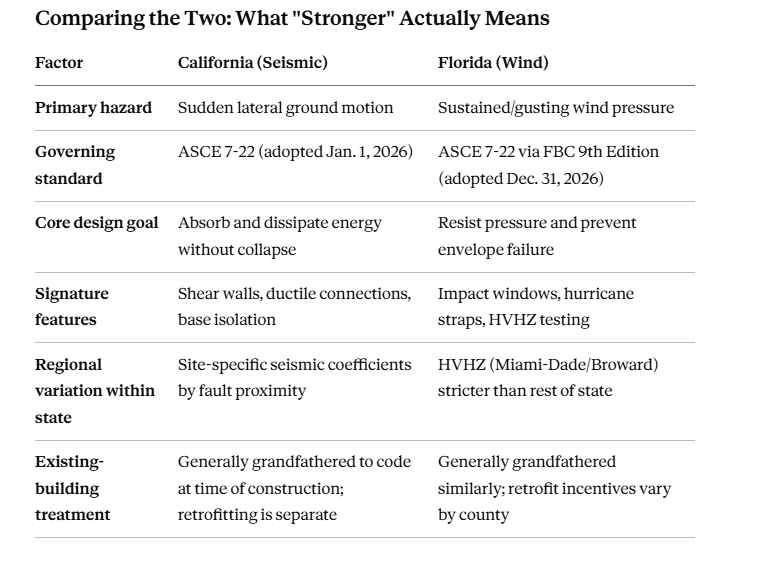
In terms of which one is worse to design against, neither really is. A building which is supposed to be earthquake-proof must bend and dissipate the energy; a building which is to survive winds cannot break under their continuous pressure, nor should any breach in its envelope occur — an open window, for instance, could raise the internal pressure and cause the roof to fail. Cost-wise and in terms of complexity, both are comparable in difficult situations.
Why It Is Important Not Just for California and Florida
The California vs. Florida debate is really only a proxy for a more universal truth about construction standards: they are hazard-specific, not just location-specific. The home in Oklahoma is designed for yet other considerations (resistance to tornadoes and hailstorms), while the house in coastal Louisiana is a combination of hurricane wind and flood elevation requirements. And when one builds or buys any structure, what matters is not whether or not the codes are strict, but what specific hazards they are strict against in light of what the actual exposure is to those particular hazards.
Frequently Asked Question
Is the building code in California stricter than the building code in Florida?
No, at least not strictly speaking — their hazards are different. The California code is based on seismology (earthquake), while the Florida code is based on hurricane force winds. Engineering costs can be significant both ways.
Should old buildings comply with current wind and seismic code requirements?
No, generally speaking, they are required to conform to the building code adopted at the time of construction rather than the present-day one unless some large-scale renovations or a change in intended use trigger compliance with updated regulations. This is an important point because many old buildings are still exposed to seismic and wind hazards in spite of the existing stringent modern code.
How does the HVHZ relate to Florida building codes?
HVHZ is a substandard of Florida building code applicable only for Miami-Dade and Broward counties, requiring buildings to pass additional wind impact tests beyond the basic standards set by the Florida statewide building code since wind risk varies within the state boundaries.
Which building code standard do most U.S. states refer to?
The majority of states rely upon IBC (International Building Code) which, in turn, refers to ASCE 7 as the national standard for seismic and wind loads among others.
Which is more costly – construction in a seismic area or construction in a hurricane-prone area?
It really depends on the site and the level of risk more than it does on the nature of the hazard. The same is true for seismic construction in the highest risk areas of California and HVHZ construction in Florida coastal counties.
2 thoughts on “Building Resilience: Are Houses Built Stronger in Earthquake Zones Than Hurricane Zones? California vs. Florida Explained”